


Main content
Press releases
Amable Liñán, Prince of Asturias Laureate for Technical and Scientific Research, has died
He was conferred the Award in 1993 for “his fundamental contributions in fluid thermochemistry, which have been decisive in understanding the combustion processes in various regimes”
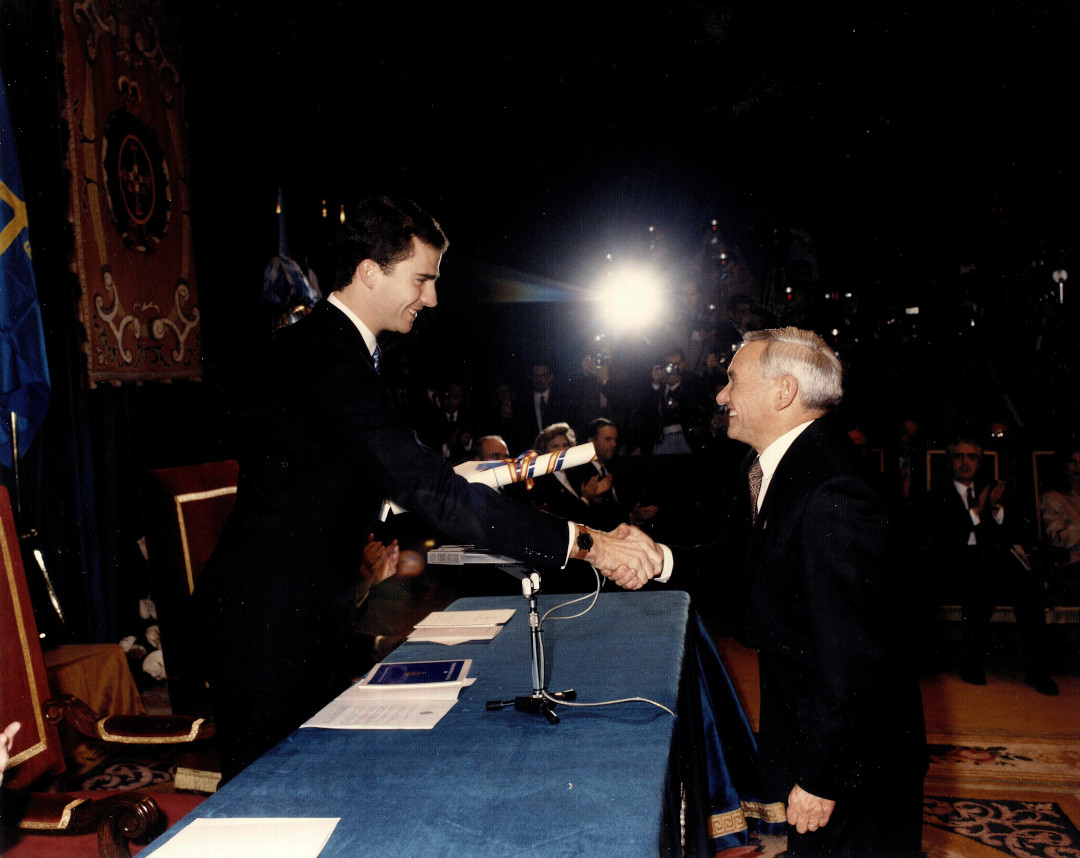
Amable Liñán, 1993 Prince of Asturias Laureate for Technical and Scientific Research, has died.
The Jury decided to bestow the Award for “his fundamental contributions in fluid thermochemistry, which have been decisive in understanding the combustion processes in various regimes, as well as the phenomena of ignition and extinction of flames in non-homogenous media, which has application for aeronautical engines: for the originality, creativity and fertility of his mathematical methods, in widespread use throughout the world; for his important studies into sequences of reactions which have clarified the processes of flame stability and structure, and lastly, for his pioneering labour in forming a Spanish school of basic research in aeronautical subjects with a wide international impact and for his untiring efforts in the training of young researchers. His work has laid a bridge between basic research and technology which shows the model to be followed”.
The Jury was chaired by Francisco Grande-Covián and made up of by Manuel Ballester Boix, Antonio Fernández Rañada, Federico García Moliner, Manuel Llamas Madurga, Juan Oró, Julio Rodríguez Villanueva, José María Segovia de Arana and José Antonio Martínez Álvarez (secretary of the jury).
The Awards Ceremony, which took place on 27th November, was presided over by HM King Felipe VI, then Prince of Asturias. Besides the address by His Majesty, the speeches at the ceremony were given by Antonio Paz, representing Vuelta magazine; María Guijarro, representing the Association for Peace in the Basque Country, and Ambassador Joseph Verner Reed, on behalf of Boutros Boutros-Ghali, former Secretary-General of the United Nations, as representative of the UN Peacekeeping Forces deployed in the former Yugoslavia, and Plácido Arango Arias, then President of the Foundation.
End of main content