


Main content
Press releases
Christina Koch, 2026 Princess of Asturias Award for Concord
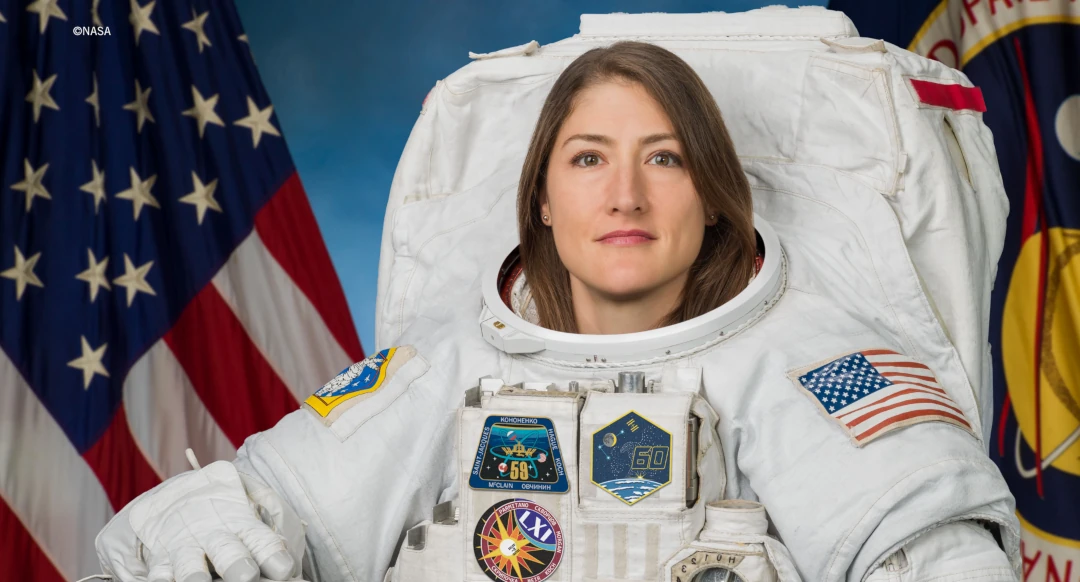
American astronaut Christina Koch has been bestowed with the 2026 Princess of Asturias Award for Concord, as announced today by the Jury responsible for conferring said Award.
Convened by the Princess of Asturias Foundation, the Jury for this Award was chaired by Adrián Barbón Rodríguez, President of the Principality of Asturias, and composed of Esther Alcocer Koplowitz, Marchioness of Casa Peñalver; Jaime Alfonsín Alfonso, Marquess of Alfonsín; Fernando de Almansa Moreno-Barreda, Viscount of Castillo de Almansa; José Ramón Álvarez Rendueles; Ernesto Antolin Arribas; José Antonio Fernández Carbajal; Joaquín Arenas de Bedmar; Antonio Brufau Niubó; Alfredo Canteli Fernández; Juan Cofiño González; Manuel Contreras Caro; Juan Carlos Escotet Rodríguez; Isidro Fainé Casas; Ana I. Fernández Álvarez; Enrique Fernández Rodríguez; Omar González Pardo; Antonio Huertas Mejías; Alicia Koplowitz Romero de Juséu; Adolfo Menéndez Menéndez; Olvido Moraleda Linares; Mercedes Oblanca Rojo; José Oliu i Creus; María del Pino Calvo-Sotelo; Matías Rodríguez Inciarte Juan Sánchez-Calero Guilarte; Antonio Suárez Gutiérrez; Javier Targhetta Roza; Gonzalo Urquijo Fernández de Araoz; Ignacio Ybarra Aznar; and Pedro de Silva Cienfuegos-Jovellanos (as acting secretary).
This candidature was put forward by Ricardo Martí Fluxá, member of the Jury for the 2026 Princess of Asturias Award for Social Sciences.
Christina Hammock Koch, known as Christina Koch, was born on 29th January 1979 in Grand Rapids, Michigan. From childhood she knew she wanted to be an astronaut, and she directed every academic and professional decision towards that goal. She graduated in Electrical Engineering and Physics from North Carolina State University and later completed a Master’s degree in Electrical Engineering, partly funded by scholarships from the Astronaut Scholarship Foundation. Her pre-NASA career included developing scientific instruments at Goddard Space Flight Center and more than three years at Antarctic research stations; with a full winter at the Amundsen-Scott South Pole Station where she served on search, rescue and firefighting teams.
Christina Koch’s career has been highlighted as an inspiration for future generations –especially for women– and a symbol of the human capacity to overcome challenges and obstacles through work, collaboration and empathy. On 1st April 2026, Koch took off aboard the Space Launch System rocket, as part of the Artemis II mission, along with Americans Reid Wiseman and Victor Glover, and Canadian Jeremy Hansen. The crew set the record for the greatest distance travelled by humans in space: 406 771 kilometres from Earth. On orbiting the Moon, Koch also became the first woman in history to travel far enough from our planet to escape its magnetic field and reach deep space, thus surpassing a boundary that no woman had crossed before. The mission concluded on 10th April 2026 and, according to specialists, the medical data collected on Koch will be crucial for planning future manned missions to Mars.
Koch’s space career began in 2013, when she was chosen to be one of the eight members of NASA’s 21st astronaut class. She completed her training in 2015 and in March 2019 travelled to the International Space Station (2001 Prince of Asturias Award for International Cooperation), where she served as a flight engineer on Expeditions 59, 60 and 61, and contributed to numerous experiments in Biology, Earth Sciences and Technology, including the testing of 3D bioprinters in microgravity. On 18th October 2019, she and Jessica Meir performed the first all-female spacewalk in history, a milestone that was repeated twice more during the same mission. On 6th February 2020, she returned to Earth after 328 consecutive days in space, the longest spaceflight record for a woman, surpassing Peggy Whitson’s 289 days. She accumulated six walks in all, spending 42 hours and 15 minutes outside the ship. Many have highlighted the milestone marked by Artemis II as an example of the potential of human beings to achieve great goals through shared effort. In the first press conference held after landing, the astronauts conveyed a message of hope, unity and concord that was highlighted by the international press. “Planet Earth, you are a crew,” Koch stated, underscoring the parallel between humanity and the crew of a spaceship, which is not just a group of people travelling together, but a bond of mutual responsibility and total interdependence in pursuit of the common good.
Holder of an honorary doctorate from North Carolina State University, Christina Koch’s accolades include the Congressional Antarctic Service Medal (USA, 2005), the NASA Group Achievement Award on two occasions (USA, 2005 and 2012), the ATHENA Global Leadership Award (2020), the National Space Club & Foundation Astronautics Engineering Award (USA, 2020) and the North Carolina Award for Science (2024).
As stated in their Regulations, the Princess of Asturias Awards are aimed at rewarding “the scientific, technical, cultural, social and humanitarian work carried out at an international level by individuals, institutions or groups of individuals or institutions”. In line with these principles, the Princess of Asturias Award for Concord is aimed at recognizing “the work of defending and advancing respect for human dignity and rights, as well as promoting and protecting peace, freedom, solidarity, world heritage and, in general, the progress of humanity”.
This year, a total of 36 candidatures comprising 16 nationalities were put forward for the Award for Concord.
This is the last of the eight Princess of Asturias Awards to be bestowed in what is now their forty-sixth year. Previously, the Princess of Asturias Award for the Arts was granted to American singer and writer Patti Smith; the Princess of Asturias Award for Communication and Humanities went to the Japanese animation studio Studio Ghibli; the Princess of Asturias Award for Technical and Scientific Research was conferred on British chemists David Klenerman and Shankar Balasubramanian and French biophysicist Pascal Mayer; the Princess of Asturias for International Cooperation went to the Svalbard Global Seed Vault (Norway); the Princess of Asturias Award for Social Sciences was bestowed on British historian, journalist and essayist Timothy Garton Ash; the Princess of Asturias Award for Sports went to Argentinian footballer Leo Messi; and the Princess of Asturias for Literature was granted to British writer Julian Barnes.
As is customary, the presentation of the Princess of Asturias Awards will take place in October in a solemn ceremony presided over by Their Majesties The King and Queen, accompanied by Their Royal Highnesses The Princess of Asturias and Infanta Sofía.
Each Princess of Asturias Award comprises a Joan Miró sculpture symbolizing the Award, a diploma, an insignia and a cash prize of fifty thousand euros.
End of main content