


Main content
Press releases
Timothy Garton Ash, 2026 Princess of Asturias Award for Social Sciences
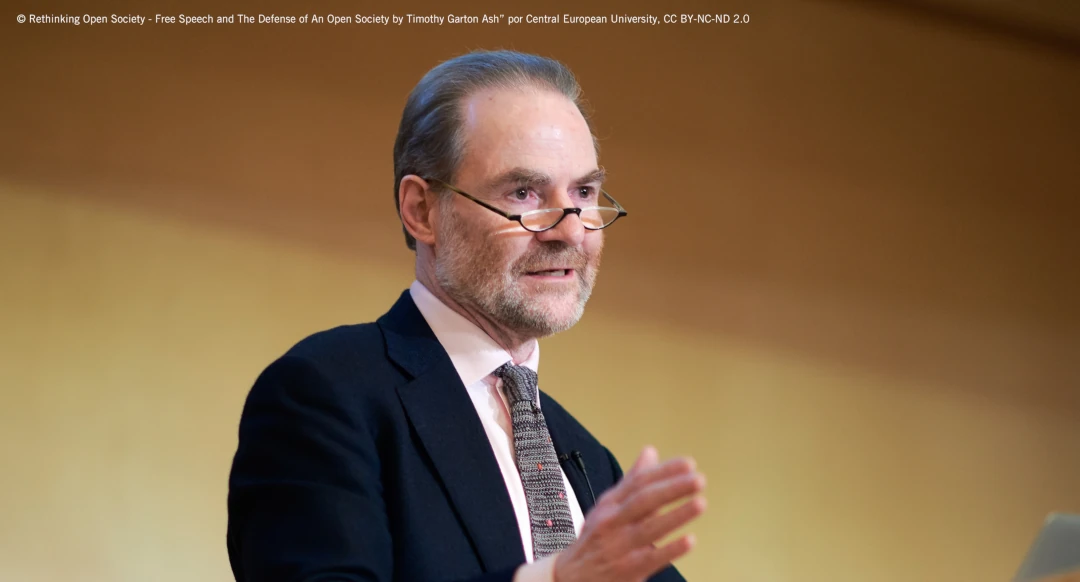
Historian, journalist and essayist Timothy Garton Ash has been granted the 2026 Princess of Asturias Award for Social Sciences, as announced today by the Jury responsible for conferring said Award.
Convened by the Princess of Asturias Foundation, the Jury for the Award was chaired by Emilio Lamo de Espinosa Michels de Champourcin and composed of Marta Elvira Rojo, Jorge Freire Gutiérrez, Teresa Freixes Sanjuán, Javier Garciadiego Dantán, Pablo Hernández de Cos, Silvia Iranzo Gutiérrez, Ricardo Martí Fluxá, Manuel Menéndez Menéndez, Sir Robin Niblett, Leandro Prados de la Escosura, María Dolores Puga González, Valerio Rocco Lozano, Fernando Vallespín Oña, Astrid Wagner and Jaime Pérez Renovales (acting as secretary).
This candidature was put forward by Rosa Navarro Durán, Professor Emeritus at the University of Barcelona.
Born in London (United Kingdom, 12th July 1955), Timothy Garton Ash graduated in Modern History from Exeter College, Oxford, in 1977. He began lecturing in 1986, always at Oxford University, where he has been Professor of European Studies since 2004 and Isaiah Berlin Professorial Fellow Emeritus at St Antony’s College. He is also a Senior Fellow at the Hoover Institution, Stanford University.
A historian, journalist and essayist, Garton Ash is recognized as one of the leading experts on the transformation of Europe in the second half of the 20th and the beginning of the 21st century, mainly in the countries of Central and Eastern Europe, and as one of the most insightful analysts of the recent history of the Old Continent. In addition to topics such as freedom, democracy and human rights, his work covers issues pertaining to global politics and international relations, which has allowed him to develop a multidisciplinary approach that merges history, political science and journalism. Experts highlight his combination of deep intellectual analysis with the use of simple, fresh language that responds to both the demands of the academic world and the interested general reader.
After reading Modern History at Oxford, his research into the German resistance to Hitler led him to move temporarily to Berlin, where he lived in both the western and eastern halves of the city. Throughout the 1980s, he reported and analysed the end of communism in various Central European countries, writing for publications such as The New York Review of Books, The Independent, The Times, and The Spectator. He was Foreign Editor for The Spectator, editorial writer on Central European affairs for The Times, and a columnist on foreign affairs for The Independent.
Author of eleven volumes of political analysis or, as he himself put it, “history of the present”, his book The Polish Revolution: Solidarity (1983) is considered one of the most influential texts on political opposition in communist Poland and the crucial role of the Solidarity trade union in the political change in the region. In The Magic Lantern: The Revolution of ’89 Witnessed in Warsaw, Budapest, Berlin and Prague (1990), he provides a very personal account of the events that marked the end of communism in Central Europe, based on his experience as a correspondent for The Guardian during that period. In Free World: Why a Crisis of the West Reveals the Opportunity of Our Time (2004), his analysis extends to the challenges facing liberal democracies, especially in a post-September 11th context, addressing the risks of globalization, populism and terrorism.
Other notable works in his bibliography include: The File: A Personal History (1997); History of the Present: Essays, Sketches and Despatches from Europe in the 1990s (2000); Facts Are Subversive: Political Writing from a Decade Without a Name (2009); Free Speech: Ten Principles for a Connected World (2016); and Homelands: A Personal History of Europe (2023).
Awarded the Order of Merit from Germany, Poland and the Czech Republic and the Order of St Michael and St George from the United Kingdom, Garton Ash holds honorary degrees from five European universities and is a member of the Royal Society of Literature, the Royal Historical Society and the Royal Society of Arts of the United Kingdom, and of the Berlin-Brandenburg Academy of Sciences, among other institutions. He has received numerous honours throughout his career, including the Somerset Maugham Award (United Kingdom, 1984), the Prix Européen de l’Essai (France, 1989), the Imre Nagy Memorial Plaque (Hungary, 1989), the Hoffmann von Fallersleben Prize (Germany, 2002), the George Orwell Prize for political writing (United Kingdom, 2006) and the Charlemagne Prize (Germany, 2017).
As stated in the Statutes of the Foundation, the Princess of Asturias Awards are aimed at rewarding “the scientific, technical, cultural, social and humanitarian work carried out at an international level by individuals, institutions or groups of individuals or institutions”. In keeping with these principles, the Princess of Asturias Award for Social Sciences is to be granted to “creative and/or research work in the field of anthropology, demography, economics, ethics, geography, history, law, linguistics, philosophy, political science, psychology, sociology or teaching, as well as in the disciplines corresponding to each of these fields.”
This year, a total of 36 candidatures comprising 12 different nationalities were put forward for the Social Sciences Award.
This is the fifth of the eight Princess of Asturias Awards to be bestowed in what is now their forty-sixth year. Previously, the Princess of Asturias Award for the Arts was granted to American singer and writer Patti Smith, the Award for Communication and Humanities went to the Japanese animation studio Studio Ghibli, the Princess of Asturias Award for Technical and Scientific Research was conferred on British chemists David Klenerman and Shankar Balasubramanian and French biophysicist Pascal Mayer, and the Princess of Asturias for International Cooperation went to the Svalbard Global Seed Vault (Norway). The corresponding Awards for Sports, Literature and Concord shall be announced in the coming weeks (in said order).
As is customary, the presentation of the Princess of Asturias Awards will take place in October in a solemn ceremony presided over by Their Majesties The King and Queen, accompanied by Their Royal Highnesses The Princess of Asturias and Infanta Sofía.
Each Princess of Asturias Award comprises a Joan Miró sculpture symbolizing the Award, a diploma, an insignia and a cash prize of fifty thousand euros.
End of main content