


Main content
Timothy Garton Ash 2026 Princess of Asturias Award for Social Sciences
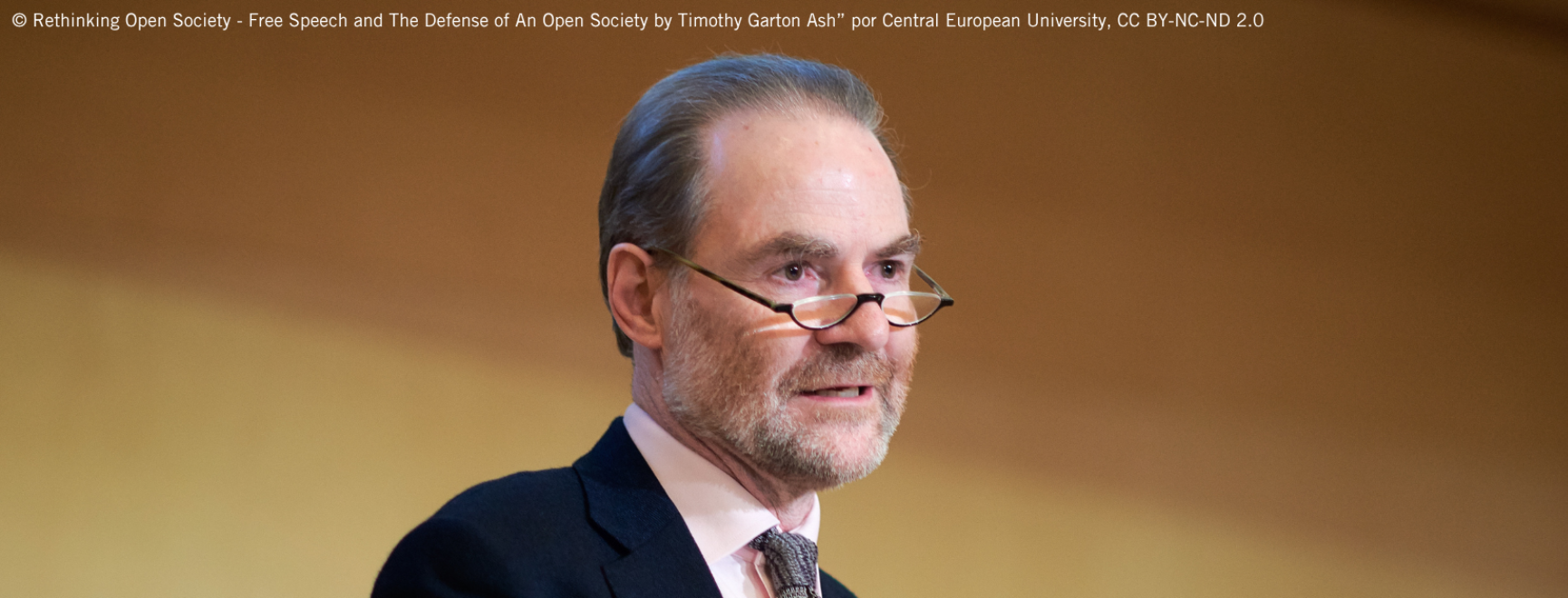
Born in London (United Kingdom, 12th July 1955), Timothy Garton Ash graduated in Modern History from Exeter College, Oxford, in 1977. He began lecturing in 1986, always at Oxford University, where he has been Professor of European Studies since 2004 and Isaiah Berlin Professorial Fellow Emeritus at St Antony’s College. He is also a Senior Fellow at the Hoover Institution, Stanford University.
A historian, journalist and essayist, Garton Ash is recognized as one of the leading experts on the transformation of Europe in the second half of the 20th and the beginning of the 21st century, mainly in the countries of Central and Eastern Europe, and as one of the most insightful analysts of the recent history of the Old Continent. In addition to topics such as freedom, democracy and human rights, his work covers issues pertaining to global politics and international relations, which has allowed him to develop a multidisciplinary approach that merges history, political science and journalism. Experts highlight his combination of deep intellectual analysis with the use of simple, fresh language that responds to both the demands of the academic world and the interested general reader.
After reading Modern History at Oxford, his research into the German resistance to Hitler led him to move temporarily to Berlin, where he lived in both the western and eastern halves of the city. Throughout the 1980s, he reported and analysed the end of communism in various Central European countries, writing for publications such as The New York Review of Books, The Independent, The Times, and The Spectator. He was Foreign Editor for The Spectator, editorial writer on Central European affairs for The Times, and a columnist on foreign affairs for The Independent.
Author of eleven volumes of political analysis or, as he himself put it, “history of the present”, his book The Polish Revolution: Solidarity (1983) is considered one of the most influential texts on political opposition in communist Poland and the crucial role of the Solidarity trade union in the political change in the region. In The Magic Lantern: The Revolution of ’89 Witnessed in Warsaw, Budapest, Berlin and Prague (1990), he provides a very personal account of the events that marked the end of communism in Central Europe, based on his experience as a correspondent for The Guardian during that period. In Free World: Why a Crisis of the West Reveals the Opportunity of Our Time (2004), his analysis extends to the challenges facing liberal democracies, especially in a post-September 11th context, addressing the risks of globalization, populism and terrorism.
Other notable works in his bibliography include: The File: A Personal History (1997); History of the Present: Essays, Sketches and Despatches from Europe in the 1990s (2000); Facts Are Subversive: Political Writing from a Decade Without a Name (2009); Free Speech: Ten Principles for a Connected World (2016); and Homelands: A Personal History of Europe (2023).
Awarded the Order of Merit from Germany, Poland and the Czech Republic and the Order of St Michael and St George from the United Kingdom, Garton Ash holds honorary degrees from five European universities and is a member of the Royal Society of Literature, the Royal Historical Society and the Royal Society of Arts of the United Kingdom, and of the Berlin-Brandenburg Academy of Sciences, among other institutions. He has received numerous honours throughout his career, including the Somerset Maugham Award (United Kingdom, 1984), the Prix Européen de l’Essai (France, 1989), the Imre Nagy Memorial Plaque (Hungary, 1989), the Hoffmann von Fallersleben Prize (Germany, 2002), the George Orwell Prize for political writing (United Kingdom, 2006) and the Charlemagne Prize (Germany, 2017).
End of main content