


Main content
Government of Guatemala and Guatemalan National Revolutionary Unity Prince of Asturias Award for International Cooperation 1997
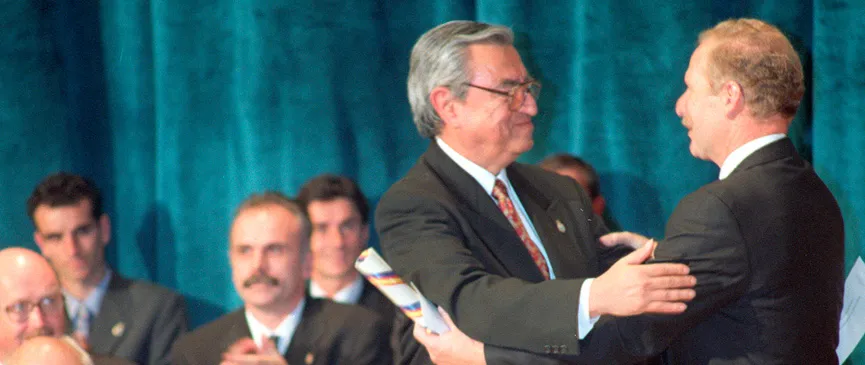
On December 29, 1996, the Peace Commission—established by the Government of Guatemala—and the Guatemalan National Revolutionary Unity (URNG) signed the "Agreement on a Firm and Lasting Peace." This accord brought an end to the armed conflict that had ravaged the country for more than 36 years—a war that resulted in between 100,000 and 150,000 deaths and the displacement of one million people.
Beginning in 1986—the year Central American presidents signed the Esquipulas Declaration in Guatemala, which outlined procedures for achieving regional peace—there were numerous agreements and attempts at negotiation aimed at ending the conflict. Ultimately, under the terms signed in December 1996, the Guatemalan government committed to submitting a National Reconciliation bill to Congress, designed to "promote a culture of harmony and mutual respect, eliminating any form of reprisal or vengeance." The agreement also provided for the creation of a commission to clarify the historical record regarding human rights violations. The process included the reintegration of URNG members into civilian life, with full guarantees for their rights as citizens. To facilitate this, both parties pledged to foster an environment of openness, tolerance, and pluralism.
On December 29, 1996, a firm and lasting peace agreement was signed between the Government of Guatemala and the URNG in the presence of United Nations Secretary-General Boutros Boutros-Ghali, bringing an end to 36 years of civil war. On behalf of the Guatemalan government’s Peace Commission—under the administration of President Álvaro Arzú Irigoyen—the agreement was signed by sociologist Gustavo Porras. Representing the URNG were Jorge Soto (alias Pablo Monsanto), Ricardo Ramírez (Rolando Morán), Ricardo Rosales (Carlos González), and Jorge Rosal, who signed on behalf of Rodrigo Asturias (Gaspar Ilom). The signing ceremony was attended by the then-Prime Minister of Spain, José María Aznar, as well as the presidents of Colombia, Costa Rica, El Salvador, Honduras, Mexico, Nicaragua, Panama, and Venezuela.
In 1997, the process of transforming the URNG into a legal political party began, concluding in 1998. For the 1999 elections, the party participated as part of a coalition of leftist parties, securing third place. In 2003, the political left ran in a divided state; the URNG fared the worst, winning only 7 of the 114 seats in the national congress. A similar outcome occurred in the 2007 general elections, where the left again ran divided, and the URNG managed to win only 2 of the 158 seats up for election.
The Secretary-General of the URNG, Commander Rolando Morán, and the President of Guatemala, Álvaro Arzú, were awarded the UNESCO Peace Prize.
End of main content