


Main content
Haruki Murakami 2023 Princess of Asturias Award for Literature
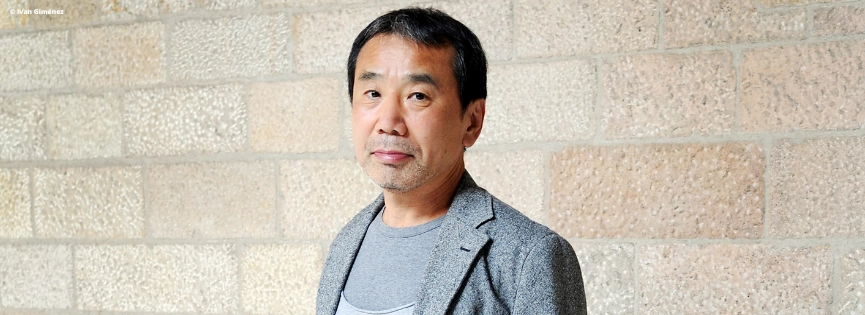
Writer and translator Haruki Murakami was born in Kyoto, Japan, on January 12, 1949. A literature graduate of Waseda University and a fan of the noir genre, he ran a jazz club early in his literary career; music has since become a defining element throughout his body of work, in which the everyday world of modern Japan converges with references to pop culture.
Having become a cult author and been translated into more than forty languages, Murakami is, according to experts, a compelling and unsettling writer. His prose reflects the influence of authors such as Dostoevsky, Dickens, Capote, and Vargas Llosa (recipient of the 1986 Prince of Asturias Award for Literature). His tone, intimate, at times surreal, and marked by elements of the implausible and the humorous, does not shy away from, but rather confronts, the most serious social issues and the struggle to defend essential human values. He emphasizes his characters' yearning for love and their profound sense of loneliness; they exist in the space between reality and the dream world, caught in a state of constant flux between certainty and uncertainty. His first novel, Kaze no uta wo kike (1979) (Hear the Wind Sing, 2015), which won the Gunzō New Writers' Prize, launched what is known as the "Rat Trilogy." This series continued with 1973-nen no pinbōru (1980) (Pinball, 1973, 2015) and Hitsuji wo meguru bōken (1982) (A Wild Sheep Chase, 1992), a work for which Murakami was awarded the Noma Prize for New Writers. He is also the author of Sekai no owari to hādoboirudo wandārando (1985) (Hard-Boiled Wonderland and the End of the World, 2009), Dansu dansu dansu (1988) (Dance Dance Dance, 2012), Kokkyō no minami, taiyō no nishi (1992) (South of the Border, West of the Sun, 2003), and the short story collections Zō no shōmetsu (1993) (The Elephant Vanishes, 2016), Kami no kodomo-tachi ha mina odoru (2000) (after the quake, 2013), Mekurayanagi to nemuru onna (2006) (Blind Willow, Sleeping Woman, 2008), Onna no inai otokotachi (2014) (Men Without Women, 2015), and Ichininsho tansu (2020) (First Person Singular, 2021). In 1987, he achieved literary success with Noruwei no mori, a title taken from the Beatles song "Norwegian Wood", which sold ten million copies in his home country and was translated into 36 languages. In Spain, it was published in 2005 under the title Tokio Blues. In 1991, he moved to the United States, where he served as a professor at Princeton and Tufts universities. He wrote Nejimaki-dori kuronikuru (1995) (The Wind-Up Bird Chronicle, 2001). That same year, following the Kobe earthquake and the sarin gas attack on the Tokyo subway, he returned to Japan to interview victims and members of the religious cult Aum Shinrikyo, which was responsible for the attack. The result of these conversations is the non-fiction work Andāguraundo (1998) (Underground, 2014), which received the Kuwabara Takeo Academic Award (Japan). Since then, he has published Supūtoniku no koibito (1999) (Sputnik Sweetheart, 2002), Umibe no Kafuka (2002) (Kafka on the Shore, 2006), and Afutā Dāku (2004) (After Dark, 2008). With his short story collection Blind Willow, Sleeping Woman, he won the Frank O’Connor International Short Story Award (Ireland). Among his recent novels are Ichi-kyu-hachi-yon (2009) (1Q84, 2011), Shikisai wo motanai Tazaki Tsukuru to, Kare no Junrei no Toshi (Colorless Tsukuru Tazaki and His Years of Pilgrimage, 2013), and Kishidancho Goroshi (2017) (Killing Commendatore, 2018 and 2019). In 2023, he published The City and Its Uncertain Walls in Japan, a work not yet translated into Spanish. He has translated the works of Raymond Carver, F. Scott Fitzgerald, Truman Capote, J. D. Salinger, and John Irving.
Recipient of the Yomiuri Prize (Japan, 1996) and the World Fantasy Award (USA, 2006), he has also received, among others, the Asahi Prize (Japan, 2006), the Franz Kafka Prize (Czech Republic, 2006), the Jerusalem Prize (Israel, 2009), the 23rd International Award of Catalonia (Spain, 2011), and the Hans Christian Andersen Award for Literature (Denmark, 2016). He was also honored with the Order of Arts and Letters by the Spanish government (2009).
End of main content