


Main content
Timothy Garton Ash 2026 Princess of Asturias Award for Social Sciences
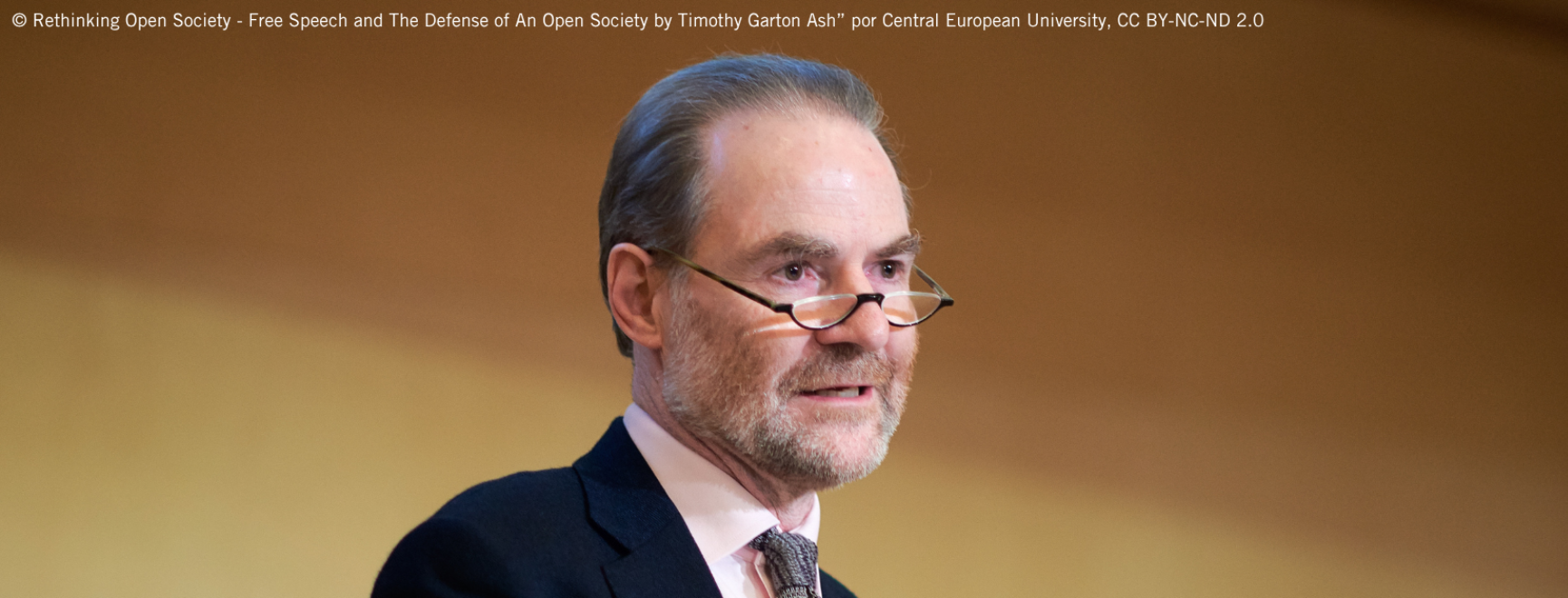
Your Majesties,
Your Royal Highnesses,
Ladies and Gentlemen,
Europe and freedom are the central themes of my life’s work. In thanking you for the signal honour of this year’s Princess of Asturias Award for Social Sciences, I would like, if I may, to address a few words about Europe and freedom directly to the Princess of Asturias.
For to be born a European in 2005, as you were, was to be born at an unprecedented high point in the spread of freedom, peace and integration across Europe. A Europe which, by the way, self-evidently includes Britain; the very first Princess of Asturias was, after all, Catharine of Lancaster. Never, in all the centuries, had we come closer to the vision of a Europe whole and free than in that golden moment around 2005.
But since then we’ve experienced such a cascade of crises, and now face such a daunting array of external and internal threats, that everything we’ve achieved since 1945 – the Europe which many in your generation take for granted – is now existentially threatened. How, for example, can we talk any more of a ‘Postwar’ Europe, when we are witnessing in Ukraine a full-scale war that has lasted longer than the First World War and cost perhaps as many as two million dead and wounded?
I will continue to contribute what I can, with pen and voice, such voice as is left to me, but the future of both Europe and freedom will increasingly depend on your generation of Europeans.
Many things will be needed to defend, reform and extend a free Europe, but let me highlight just three.
First, what I hope you’re already finding at university: a profound commitment to the search for truth, based on critically scrutinised evidence and verified facts. In his book The Historian’s Craft, the great historian Marc Bloch identifies several periods of European history in which, I quote, ‘it was as if a vast symphony of deception resounded from one end of Europe to the other’. Now we’re probably entering another such period, with another ‘vast symphony of deception’ being played by social media, AI, hostile powers and some people in very high places. The role of truth-seeking professions, such as my own, academia and journalism, but also the law – as represented, for example, by the International Criminal Court in The Hague – will be more important than ever.
Second, trust. Liberal democracy is now experiencing a profound crisis of trust, almost everywhere in Europe, and not least among younger Europeans. That trust has to be regained. This will depend not just on good policies but also on respected, steadily adapting institutions and the contributions of individual human beings in all parts of society.
Finally, to keep the sequence of ‘t’s and use a Spanish word, tiquitaca. Is it possible to speak in Spain in the year 2026, and in the presence of Lionel Messi, without mentioning football? Well, clearly, it’s impossible, because I just have. The lesson from football for Europe is that success requires both individual genius and sophisticated teamwork. Each individual player has their own special talent, attacking, defending or in midfield, yet all work as one if they can achieve the amazing rapid-passing Spanish game, in which everyone seems almost miraculously to know not just where everyone else is – but where they'll be in about five seconds time.
Ladies and gentlemen, if only the nations, states and regions of Europe could do the same, combining –as Europe at its best always has– diversity and unity, we would be unbeatable.
Thank you once again for the honour you have done me. I shall treasure it as I return tomorrow from one great European country to another.
End of main content